You're exhausted. You're overfunctioning. You've achieved everything you were supposed to — and you still don't feel like enough. That's not a motivation problem. That's an identity problem.
I help high-achieving people stop performing and start becoming. Because the answer isn't working harder. It's learning how to DEAL with your PAST.
Where do you want to start?
I spent 20 years in healthcare — first as an ICU nurse for 10 years, where you learn fast that most people are completely unprepared for the moments that actually define them. Then as a Nursing Director, leading teams through the kind of pressure most people never see. Then as a Corporate Nurse in Healthcare IT, deploying Oracle Cerner and Epic across 78+ hospitals at Tenet Healthcare. I became very good at solving complex problems in high-stakes environments.
What I didn't realize was that I was simultaneously becoming very good at overfunctioning. Being exactly who every system needed me to be. Performing competence. Earning my place. Running on fear disguised as ambition — and calling it strength.
"I was the person people called in a crisis. The one who handled everything. The one who never fell apart. Until I did."
What I discovered on the other side became ICU-1111 and the DEAL Framework — not generic positivity, but a real clinical philosophy forged in critical care, tested in boardrooms, and refined through the messy, nonlinear process of rebuilding an identity from scratch. I founded ICU-1111 for the people who've spent their lives feeling unseen, no matter how hard they worked to be enough. I See You — that's the quiet intention behind the name.
Most pain traces back to one of four patterns. Five questions. No fluff — just clarity about what's actually happening beneath the surface.
Your gut reaction. Not what you think you should feel — what you actually feel.
Think about work, relationships — anywhere you feel the pressure to perform.
Your real pattern — not the one you wish you had.
The pattern that keeps repeating — even when you try to change it.
Not earned rest. Not a vacation. Just being, without producing, pleasing, or achieving.
Somewhere along the way, you learned that love and belonging were things you had to earn — through performance, capability, or being needed. You're not broken. You're exhausted from auditioning for a role you already deserve.
You've been holding more than you've been letting yourself feel — and that compression is looking for a way out. What's been building in you isn't weakness. It's unattended truth, asking to be heard.
You've likely been drawn to people or situations that echo something familiar — not because you're weak, but because the familiar feels like home, even when home wasn't always safe. Understanding this pattern is the beginning of choosing differently.
The giving isn't the problem — it's that somewhere you learned your needs come last. You carry everyone else's weight while quietly depleting. You can't pour from empty. And you deserve to be poured into too.
"Incomplete identity is the source
of every pattern." — Anju Redheendran
Every painful relationship pattern, coping strategy, and identity crisis traces back to one of four patterns. Your past isn't just what happened to you — it's what's still running you.
Wounds recognize wounds
We're drawn to people who carry wounds similar to our own — not consciously, not as a flaw. It's the nervous system doing what it knows. Understanding this principle is how you stop repeating patterns and start choosing differently.
Giving from fear, not fullness
When love feels conditional — earned through performance, sacrifice, or being needed — we spend our lives auditioning. This principle names the difference between giving freely and giving as a survival strategy.
Pressure reveals unattended truth
Crisis doesn't create character — it reveals it. When life squeezes you, what comes out is whatever's been unaddressed. The Squeeze teaches you to stop running from pressure and start listening to what it's trying to show you.
You only love from what you carry
You cannot give what you don't have. Every relationship, every role, every act of service comes from what's already in your tank. This principle is about what you're actually carrying — and whether it's enough to sustain the life you're living.
Most people think their biggest challenge is the crisis in front of them. It isn't. It's that nobody ever taught them how to move through life's hardest moments without losing themselves in the process.
Learn the full framework
In our sessions, she helped me through past hurts I hadn't really understood. I learned to care for myself better and to understand that things in my childhood were not my fault. It has been healing on many levels and given me closure and peace.
Joy W · Long-term clientAnju is empathic and compassionate, but also has an inner strength that will help you find your own. She helped me help myself — which is a gift. She encouraged me to set boundaries, helped me understand my strengths, and even tipped me off on a change that helped heal an autoimmune condition now in remission.
Start your own story
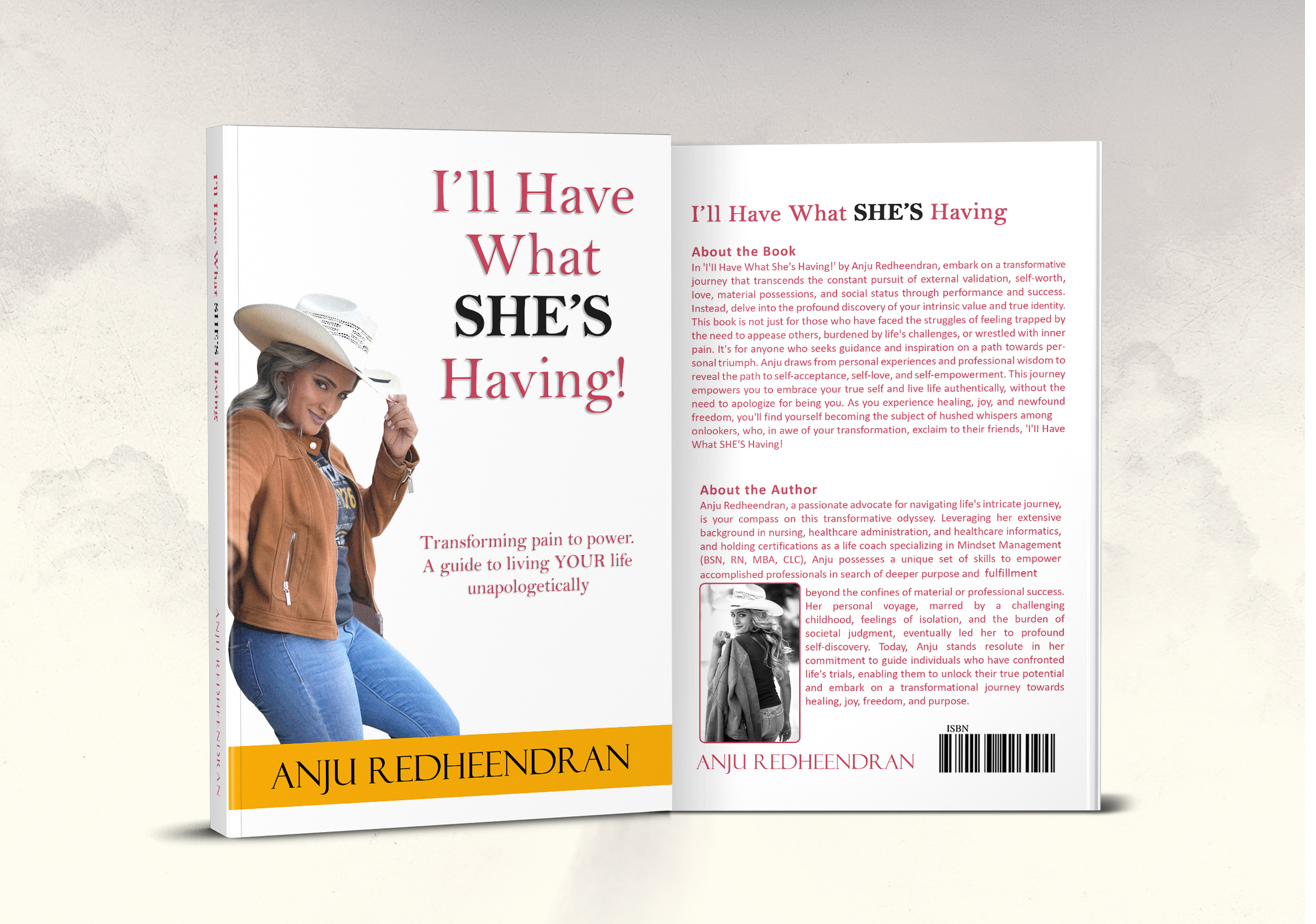
I'll Have What SHE's Having! is not a book about comparison. It's about recognition — that moment when you see someone living with ease, confidence, or peace, and something in you whispers: that's what I want. This book is about learning how to want that for yourself. And then actually building it. Written from real loss, real betrayal, and the transformative power of owning your entire story.
Whether you've just gone through a personal crisis or you've been quietly losing yourself for years — the 30-minute call is where we figure out if working together makes sense. No pitch. No pressure. Just clarity.
RN, BSN, MBA, CLC with two decades of healthcare operations and informatics leadership. Open to the right conversations in healthcare IT.